Question
I enter a maximum Mp value for an engineered element and, after the analysis, the bending moment in the element equals that value. For example, if I enter the material property Mp = 100kNm, the analysis shows the maximum moment developed in the element is 100kNm. If I enter 200kNm, the analysis reports 200kNm and so on. This continues until the Mp is raised beyond an upper threshold.
Does this suggest the element has failed? How do I know what the bending moment is in the element if it keeps varying with the defined strength?.
Solution
If the value of Mp calculated for the sheet pile is equal to the value specified then it implies that the element would fail as part of the critical mechanism. However, if the adequacy factor is greater than 1.0, the model is deemed safe for the conditions specified.
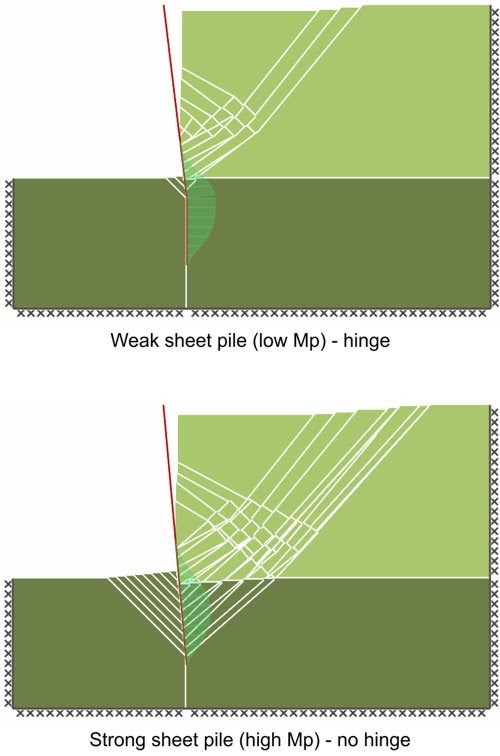
For low values of Mp, if you animate the solution, it is likely that you will see a hinge forming in the element (see image). However, if you increase the value of Mp, it is likely that you will reach a point where the element acts a single rigid entity. For example, in the attached files a sheet pile wall resides in two layers of strong(ish) clay. In the first file (weak) the Mp is low and the wall hinges. Here the bending moment shown is equal to the Mp value for the element. In the second file (strong), the Mp value is high and the wall acts monolithically. Here the bending moment is lower than the capacity of the element.
It should be noted that the use and interpretation of stress / moment diagrams from the software is valid only for those areas that are yielding or adjacent to yielding zones. This relates to the nature of ultimate limit state analysis and is explained further in the User Manual.